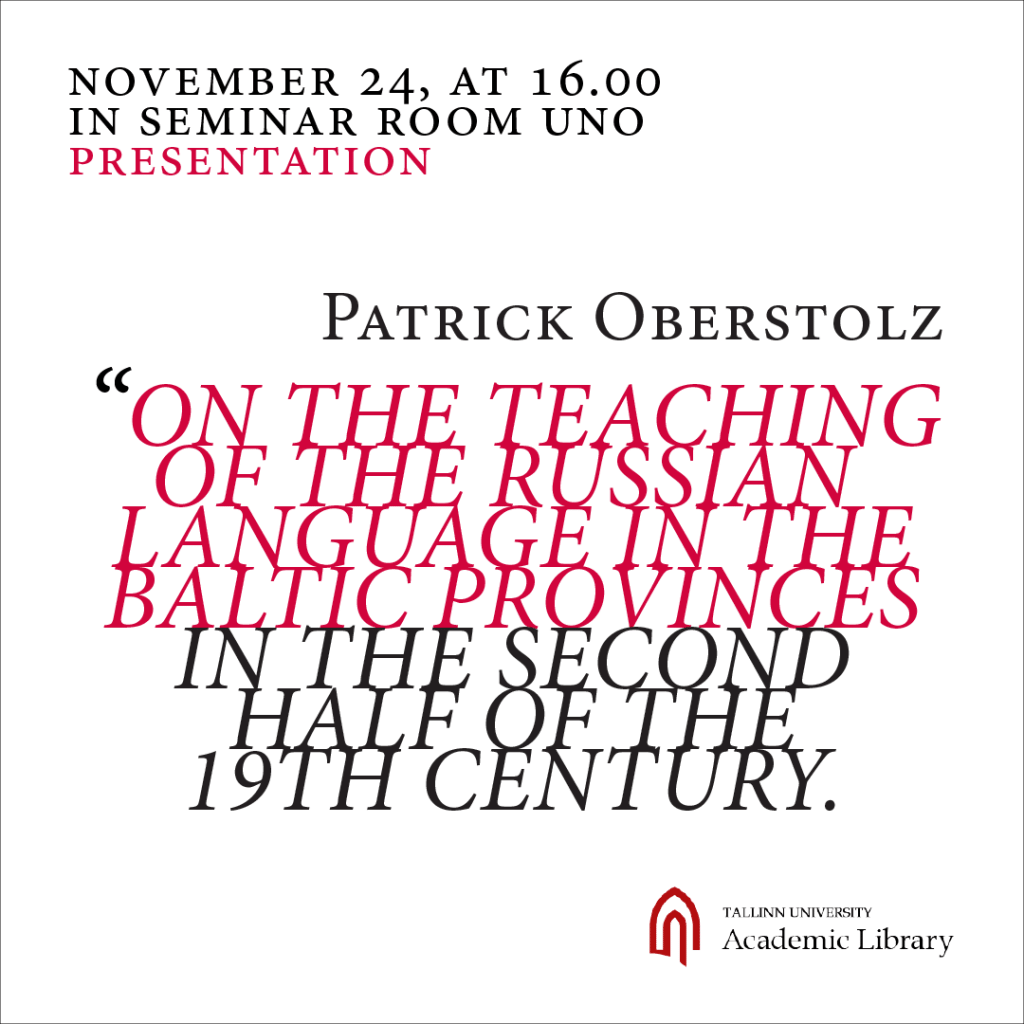
On Tuesday, November 24, at 4 PM, Patrick Oberstolz – a doctoral student in Slavic studies at the University of Vienna and one of the recipients of the 2026 Baltica foreign researcher grant at Tallinn University – will deliver a presentation titled “On the Teaching of the Russian Language in the Baltic Provinces in the Second Half of the 19th Century.” The presentation will be held in the UNO seminar room of the Academic Library of Tallinn University, and it is in English. All are welcome to attend!
How did Russian textbooks turn grammatical knowledge into something learners were expected to do? This talk explores that question through Russian teaching materials used in the Baltic provinces during the second half of the nineteenth century. It focuses on Johann von Pihlemann, Fedor Vasil’evič Golotuzov, and Carl Heinrich Niggol, comparing how their works are organized and what changes occurred across surviving editions. The talk examines the tasks assigned to students, ranging from translating sentences and identifying or explaining verb forms to retelling passages, answering questions, and completing written exercises. It also asks what learners are given in advance, what they must supply themselves, and how teachers are expected to guide the process. Literary material also serves different purposes depending on its setting: the same kind of text can support grammatical analysis, language practice, or a broader reading program. The analysis draws on curricula and school reports to connect textbook tasks with official expectations and reported classroom use; it also considers how gymnasia, elementary and parish schools, and teacher training institutions differed in their pupils, language teaching, and resources. The talk then examines the staged introduction of Russian as a medium of instruction in the late 1880s and early 1890s, distinguishing it from the teaching of Russian as a subject. These institutional changes provide a framework for asking how older books and established teaching practices were either retained, combined, or adapted.
The presentation can also be viewed online.